

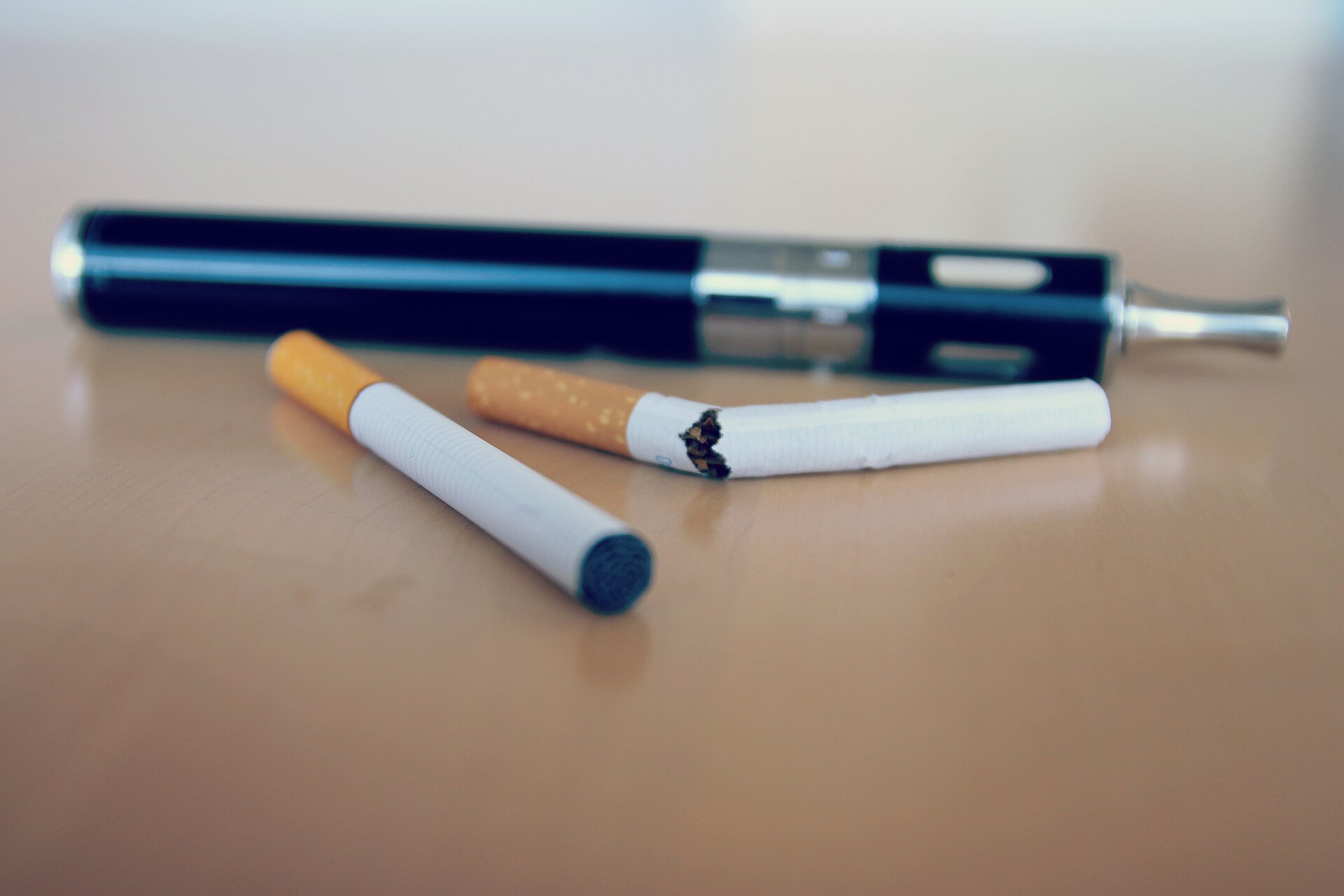
Quitting smoking sets lung cancer risk on a downward path — that much is settled science. The unsettled question trails one step behind: if the quitter now vapes, does the risk fall at the same speed, more slowly, or not at all? It sounds like a question research should have answered by now, yet the honest reply requires separating what has been measured (exposure, which falls sharply) from what has not (cancer outcomes over the decades the disease needs to develop).
That distinction is not evasive; it is the actual shape of the evidence. Working through it carefully gives ex-smokers who vape a realistic picture instead of either false comfort or unnecessary alarm.
The decline that quitting starts
Every smoke-free year improves the outlook. According to the National Cancer Institute, people who quit smoking lower their lung cancer risk substantially compared with those who continue, and the advantage grows with time — though heavy, long-term smokers may retain above-average risk for many years. This slow decline reflects biology: damaged cells are gradually cleared, inflammation subsides, and no new carcinogen load arrives with each cigarette.
The arrival of a substitute exposure is exactly what complicates the new question. If vaping added nothing at all to the lungs, the post-quit decline would presumably proceed as it does for people who quit outright. If it adds a small ongoing exposure, the decline might be slightly blunted. Measuring the difference between those two curves requires very large groups followed for a very long time — studies that are under way but nowhere near maturity.
Exposure after the switch, in numbers
In the shorter term, researchers measure what the body absorbs. Cigarette smoke delivers thousands of chemicals, including dozens of proven carcinogens created by burning tobacco. E-cigarette aerosol, as the Centers for Disease Control and Prevention outlines, generally contains far lower levels of those substances and none of the carbon monoxide, because the liquid is heated rather than combusted.
Studies of former smokers who switched completely find the expected pattern inside the body: steep falls in tobacco-specific nitrosamine metabolites and several other carcinogen markers, often to a range similar to that of people using medicinal nicotine. That is the strongest available evidence that switching changes the risk equation favourably compared with continued smoking. It is not, however, evidence that the equation returns to zero: aerosol still carries ultrafine particles, and under some conditions carbonyls and metals, deep into the respiratory system.
What could keep the risk from falling as fast
Three concerns recur in the literature. The first is duration: nicotine dependence can extend vaping for years, and chronic low-level exposure is precisely the pattern whose effects take longest to detect. The second is product variability — device power, coil age and liquid ingredients all shift the aerosol’s chemistry, so ‘vaping’ names a family of exposures rather than one. The third is laboratory evidence that, in some experimental settings, aerosol constituents produce oxidative stress and DNA-damage responses in lung cells, findings the World Health Organization cites among its reasons for treating long-term effects as unresolved.
Set against those concerns is the counterfactual. For the population actually asking this question — people who would likely still be smoking without a substitute — the alternative exposure is not clean air but cigarette smoke, whose carcinogenicity is not speculative at all. Risk assessments that ignore the counterfactual mislead in the opposite direction.
A balanced verdict for ex-smokers who vape
On current evidence, the defensible conclusions are these. Switching completely from smoking to vaping almost certainly reduces carcinogen exposure by a large margin, and exposure is the raw material of risk. Whether vaping slows the post-quit decline in lung cancer risk by a small amount is unknown and may remain so for years. Dual use, meanwhile, clearly undermines the benefit, because it keeps combustion in the picture.
Readers can browse more of our coverage from our blog, where explainers like this sit alongside technology and business reporting. For anything personal — screening eligibility after a long smoking history, help tapering nicotine, or symptoms that worry you — the right step is an appointment with a doctor or another healthcare professional. Population-level research sets the context; it cannot examine your lungs.
